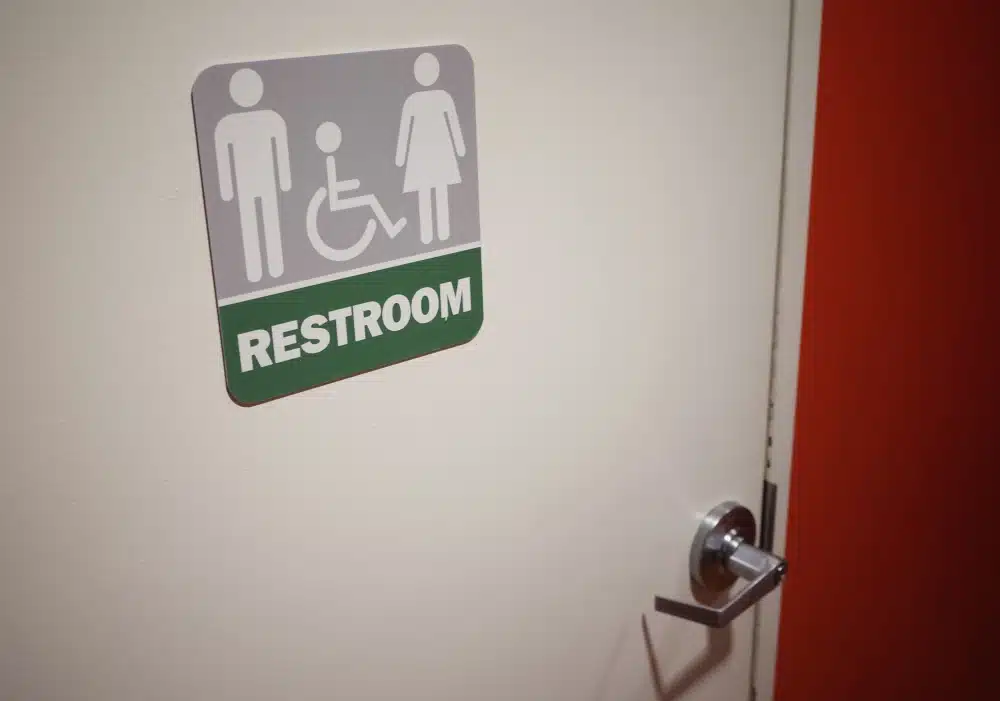
The “Texas Bathroom Bill,” SB 8, takes effect Thursday, December 4th. It requires any building that a political subdivision or state agency owns, operates, or controls to take “reasonable step[s]” to limit multi-occupancy restrooms to sex assigned at birth. In plain language, this cruel and dangerous bill requires publicly owned buildings to exclude transgender and nonbinary Texans from using bathrooms and changing facilities that align with their gender identity.
SB 8 also requires family violence shelters that contract with the State Health and Human Services Department to refuse service to transgender women, and for Texas jails to house incarcerated people according to their sex assigned at birth.
What Buildings Are Affected?
The bill covers a wide range of publicly-owned buildings, from public schools and universities to courthouses and libraries. This definition even extends to buildings owned by the Dallas Office of Arts and Culture such as the Latino Cultural Center, Kalita Humphreys Theater, the Dallas Museum of Art, and more. Many public park restrooms are also covered under the law as city-owned property. You can find a map of all City of Dallas-owned property here, and a list of Dallas-owned cultural venues here.
Single-use restrooms and privately-owned buildings are not covered under this law.
How is the bill enforced?
The bill itself only mentions penalties, offering no guidance on enforcement. What are the “reasonable steps” building owners must take to police bathrooms? How will they know when someone is using the “wrong” restroom? Will residents who want to make a report know to do so in writing to the municipality that owns the building? Or will they attempt to enforce the law themselves, creating a dangerous and degrading environment for the community?
The penalty for breaking the law is a hefty fine of $25,000 for the first violation and $125,000 for each violation after. Importantly, the bill itself doesn’t penalize individual transgender Texans but the political subdivision that owns the building, like the city, county, or state. This means that transgender Texans who are simply using the restroom should not face fines under this law.
What’s next?
Federal appeals courts around the country have consistently found similar bathroom bills focused on public schools unconstitutional. In fact, earlier this year, the U.S. Supreme Court refused to hear a case about a public school bathroom bill in Indiana, which allowed the student in the case to continue using the restroom that matches his gender identity.
The first “bathroom bill” was introduced in Texas in 2015. It has taken anti-LGBTQIA+ forces almost a decade to actually enact it because of the strength of our community’s advocacy. The Texas LGBTQIA+ community is incredibly resilient, and we have a long history of supporting each other.
SB 8 affects only publicly owned buildings, which makes privately-owned safe spaces more important than ever. Resource Center was made by the community, for the community to be a safe space in the heart of Dallas. The Center’s housing development, Oak Lawn Place, was created specifically to be an affirming and welcoming community for LGBTQIA+ seniors.
The DFW region is also lucky to have a strong network of partners that have mapped out and vetted local organizations and businesses that support the LGBTQIA+ community. The Dallas Hope Charities resource guide is a fantastic place to find safe places, as is the North Texas LGBTQ Chamber of Commerce. Apps like Everywhere is Queer allow queer-owned businesses to join their network and provide a handy visual map, so users always know if there is an LGBTQIA+ friendly space near them.
Bills like SB 8 are intended to erase the LGBTQIA+ community from public life, but words on a page will never negate our day-to-day lives. We will continue living and thriving in the places we call home, and we will keep creating spaces that allow us to be our full selves.
If you, or someone you know, is in need of a supportive community for LGBTQIA+ youth, check out Resource Center’s Youth and Family Services. To stay in the loop as these battles continue, sign up for our advocacy alerts here.